
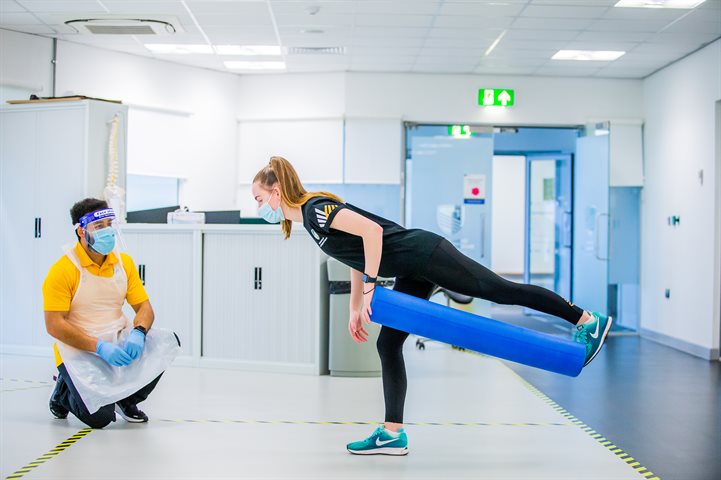
Athletic rehab programs differ from your basic home exercise plan by taking a more aggressive approach to regaining your strength and returning to sport. Let’s talk about how sports-specific rehab programs from Alpha Sports Performance Medicine work.
Rehab Programs Start With Clinically Assessing Your Injury
You cannot improve something if you do not know what is injured.
Your rehab program should start with finding out exactly what is hurting. Where are you feeling pain? What movements cause symptoms? What feels normal?
Your initial evaluation should include…
History and Symptoms
Physical examination
Movement assessment
Clinical Tests
Your medical professional will test joint range of motion, ligamentous stability, strength deficits, and nerve function to narrow down what specific tissues may be injured.
Once we have compiled objective data from your physical examination and movement assessment, we can quantify your strength ratios, hop testing scores, and gait mechanics.
As you progress through rehabilitation, these objective benchmarks and validated scores allow your physical therapist to track your improvement and synchronize rehab exercises to a calculated return to sport date.
This way you leave your sessions with a detailed rehab plan rather than a prescription of random exercises.
Sports Rehab Must Include Movement Screening
If you’ve suffered an injury that has kept you sidelined, chances are your movement is not where it was before you got hurt.
The old adage that “you don’t know what you don’t know” is especially true with movement patterns.
Poor movement mechanics may have contributed to your injury or they may be completely unrelated. Either way, correcting form for exercises, squats, runs, jumps and other sports-specific movements is crucial to your recovery.
During your movement assessment, your physical therapist can identify areas of asymmetry, compensations, or muscle imbalances through a variety of tools including video motion analysis and wearable tech.
From there, you can work with a trainer or athletic therapist to create a targeted strategy to improve your movement quality and athletic performance.
Progressive Mobility Drills Improve Range Of Motion And Strength
Unlocking stiff joints and increasing your range of motion goes beyond stretches.
Dynamic mobility drills emphasize moving your joints through a full range of motion while under load. Not only does this increase flexibility, it also helps build strength throughout your new range.
Joint mobilizations and soft tissue work can help improve small accessory motions in your joints to allow for pain free motion.
Active stretching can also train your muscles to allow for increased range of motion while building stability.
By pairing these mobility drills with stability exercises your body will be less likely to regress back to its prior limited range of motion.
Load And Strength Are Increased Progressively
After mobility and stability have been addressed, it’s time to focus on rebuilding strength.
Rehabilitation exercises will slowly progress in load, complexity, and speed as your body tolerates the stress.
For example, strength ratios between your injured limb and non injured limb should be close to equal (90%+) before high demand activities are resumed.
Clinicians use a combination of concentric to eccentric strength ratios, power outputs, and endurance testing to help clear you for sport.
It is also important to progressively load the injured tissue to build up strength and endurance. Your therapist will monitor your response to exercise sessions by asking how you felt following the workout.
Did you experience swelling? Was there soreness beyond 24-48 hours? How did your energy level feel the next day?
These questions help your therapist progress your load while reducing the risk of setbacks.
Functional Testing Helps Dictate Return To Play
Once you can pass strength, mobility, and load benchmarks it’s time to see how you perform.
Just like at the start of your rehab program, sport-specific functional tests will help determine if you are ready to get back in the game.
These may include timed runs, agility tests, and single leg hop testing for symmetry.
Sport-specific movements are simulated to ensure you can handle the work load and maintain proper mechanics when fatigued.
Not only does this give your therapist peace of mind that you are ready, but it should prevent you from returning to sport too soon and risking reinjury.
Psychological Factors Are Also Important
While regaining your strength and improving mobility are important factors for returning to play, there is also a mental piece to rehabilitation.
How do you feel about your injury? Are you scared to perform a certain movement because you might reinjure yourself?
These are all valid questions that should be addressed through validated readiness to return to play questionnaires and graded exposure to sport specific stressors.
Sports-specific preparation allows athletes to rebuild confidence in their body and prepares them mentally for game day conditions.
Return To Sport Rehab starts with a Comprehensive Evaluation
Sports rehabilitation is a process that should be taken step by step. The athletes you see here at Alpha Sports can perform advanced movement assessments, strength testing, postural analysis, and much more!
Rehab doesn’t have to be scary or generic, let us show you!
Frequently Asked Questions
How is sports rehab different from regular rehab?
Sports rehab has the specific goal of returning you to sports. Regular therapy focuses on pain relief and may not address the underlying cause of poor movement mechanics.
How quickly do sports rehab programs work?
Rehab depends on many factors but progression will be obvious by weekly improvements in your strength and ability to perform your exercises.
How do I know when I’m ready to play?
Being cleared to play is a combination of strength testing, functional movement drills, and being able to tolerate your sports workload.
Will sports rehab prevent me from getting injured again?
Studies have shown that once you correct your form, rebuild strength, and slowly progress back to your pre injury levels your risk of reinjury is greatly reduced.
Do I need a doctor’s referral to start physical therapy?
This depends on who you see. Many athletic trainers and physical therapists will see you without a referral to determine if you are a good candidate for their services.